The Regime Investor· · ·9 min read
What would make Arctic and Middle Corridor routes investable
Pilots, border hand-offs, infrastructure, insurance and cargo fit must be proven before either route becomes an investable alternative
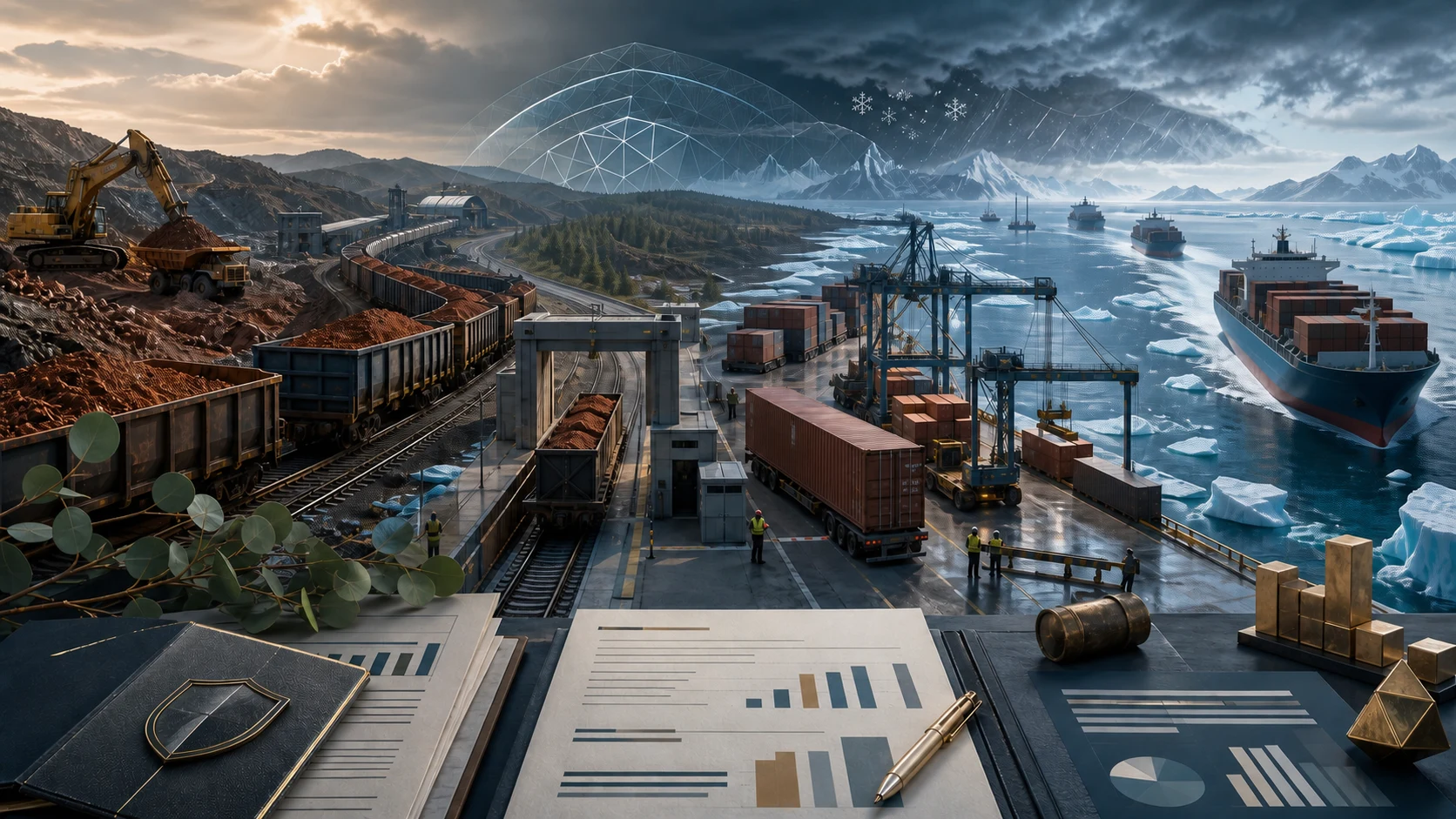
One container ship leaving Busan, new investment platforms in Central Asia and a critical-minerals dialogue with Mongolia all point towards a search for more resilient Eurasian supply chains. They do not yet form one route, and they do not create revenue for an Australian company merely because the company mines, ships or finances commodities.
The investment question is narrower than the geopolitical story. A route becomes useful when cargo can move through every sea, rail, port and border hand-off at a repeatable cost. It becomes relevant to a portfolio only when that operating result changes a holding’s contracts, capital needs, margins or competitive position. The current evidence establishes several serious experiments; it does not establish a commercially integrated alternative to existing trade lanes.
A live voyage can test a route without proving a service
Korea’s Ministry of Oceans and Fisheries says the 2,758-TEU Panstar Acro left Busan on 22 August for a 45-day return pilot through the Northern Sea Route. Its itinerary includes Felixstowe, Rotterdam and Gdansk before the ship returns to Busan. This is more useful evidence than a map or memorandum because a real vessel, crew, cargo and insurance arrangements are being exposed to actual operating conditions.
At the 25 August evidence cut-off, however, the voyage had only begun. There was no completed record of transit time, fuel use, cargo integrity, ice assistance, port delays, schedule reliability or total cost. A successful return would answer whether this ship could complete this voyage in this seasonal window. It would not by itself show how frequently the service can run, whether customers will commit enough cargo, or whether the economics survive across different ice and freight-market conditions.
The distinction matters because a scheduled service sells reliability as well as distance. A manufacturer cannot plan inventory around a route that is shorter in theory but available only irregularly. The first commercially meaningful comparison is therefore not kilometres saved. It is the all-in cost and arrival-time distribution against the customer’s existing route.
Polar operating constraints sit inside the freight rate
The International Maritime Organization’s Polar Code covers ship design, equipment, operational limits, officer training, voyage planning, search and rescue, and environmental protection. The IMO also notes the difficulty created by remoteness, limited navigational information and the reduced effectiveness of equipment in cold conditions. These are not peripheral compliance details. They determine which ship can sail, when it can sail, what contingency support it needs and what an insurer will charge.
A useful route comparison would separate bunker fuel, canal or route charges, ice or escort services, additional crewing and equipment, insurance, expected delay, port handling and the inventory cost of an uncertain arrival. A shorter sailing can still be dearer if a low-frequency departure forces a customer to hold more stock or if one disruption erases the time saved across several successful voyages.
Cargo type also sets a boundary. A container pilot can test a lane for manufactured goods or containerised inputs. It says little about the economics of crude oil, LNG or bulk ore, which use different vessels, terminals, contracts and insurance. Investors should resist turning one Arctic trial into a general answer to every supply-chain disruption.
The Middle Corridor is only as fast as its slowest hand-off
The World Bank’s Middle Trade and Transport Corridor study describes a multimodal route linking Chinese and European markets through Central Asia and the South Caucasus. Freight moves across rail networks, the Caspian Sea, ports and borders rather than remaining on one train under one operator. The Bank estimates that a combination of investment and efficiency measures could halve travel times and triple freight volumes by 2030.
That forecast is conditional. Rail capacity can increase while a port queue, customs process, incompatible data system or poorly aligned timetable leaves the end-to-end journey little changed. Average transit time is also insufficient on its own: a customer deciding how much inventory to hold needs to know the variation around that average. The evidence should therefore be collected by hand-off—dwell time at each border, trans-shipment capacity, missed connections, cancellation rates and the share of cargo arriving within the promised window.
The US–Uzbekistan Joint Investment Platform gives the US International Development Finance Corporation and Uzbekistan a framework to identify projects in energy, critical minerals, transport, logistics and manufacturing. It may help individual assets find capital. It is not an end-to-end financing commitment for the whole Middle Corridor, a completion timetable or a transport contract with an Australian exporter. Project announcements must remain attached to the particular link they fund.
Mineral diplomacy still needs a mine-to-customer chain
The US–Mongolia–ROK Critical Minerals Dialogue established information exchange and discussion of joint initiatives. That can improve project discovery and government coordination. It does not settle ore grade, approvals, processing, finance, transport or offtake.
For a landlocked mineral project, logistics is part of the asset economics. An investor needs to know where the material will be processed, which road or rail network will carry it, how borders and ports will be crossed, which party bears delay and currency risk, and whether a creditworthy customer has agreed to take the product. A resource estimate without a viable transport and sales chain can remain stranded even when diplomatic support is strong.
This creates both competition and possible opportunity for Australian miners. New supply may pressure a commodity price or compete for customers and capital. Conversely, Australian engineering, processing or mining-service providers may win work, and diversified buyers may place greater value on reliable Australian supply. Neither outcome should be assigned to an ASX company without a project interest, tender, order, offtake agreement or other disclosed link.
A North Korean connection is a legal case before it is a route case
A rail connection through North Korea can look like the missing line on a Eurasian map. In practice it would require agreement among every relevant state, customs and payments arrangements, financing and insurance, compatible rolling stock and signalling, and an operator able to coordinate the complete journey.
The legal hurdle comes first. The United Nations 1718 sanctions regime includes restrictions on joint ventures and cooperative entities with DPRK parties, financial support for trade, and transfers of industrial machinery and transport vehicles, with specified approval and exemption processes. A geographic possibility cannot be included in a commercial cost model until the parties can identify a lawful structure and the approvals it requires.
Sanctions clearance alone would not prove investability. The route would still need funded infrastructure, operating agreements, insurable counterparties and contracted cargo. Treating political interest as though it had solved those later steps collapses several independent risks into one optimistic assumption.
Australian exposure begins with a company filing
Australia’s Critical Minerals Strategy 2023–2030 seeks investment, international partnerships and enabling infrastructure for the domestic sector. A more diversified global supply chain is relevant to that policy setting, but national strategic relevance and shareholder value are not the same measure.
For each portfolio holding, the route thesis can be tested against five questions:
- Does the company own an asset, sell a service or buy an input on the proposed corridor?
- Is there a named customer, project counterparty or transport contract?
- Would the route change delivered cost, available volume, inventory days or required capital?
- Does the company have capacity to capture the opportunity without disproportionate new spending?
- When should the effect appear in orders, guidance, working capital and cash flow?
The first evidence should be in project documents and company filings, not a list of securities that happen to contain the words shipping, infrastructure or critical minerals. If management later attributes growth to a corridor, the claim should reconcile with contract volumes, utilisation, margins and cash conversion. The same discipline used to test whether reported ASX earnings become cash applies to a new logistics theme.
Portfolio context matters too. A global fund may already own foreign rail, port or shipping operators even when no ASX issuer has direct exposure. Commodity holdings can respond to new supply, while higher geopolitical risk or freight costs can affect discount rates across the portfolio. This is why a route should be analysed within the broader market regime , then traced to each holding rather than treated as a stand-alone trade.
Evidence should advance in a recognisable sequence
Each proposal has its own next proof point. For the Arctic pilot, the sequence runs from completed voyage data to repeated sailings, insurable terms, customer commitments and profitable utilisation. For the Middle Corridor, it runs from funded upgrades and border reform to lower end-to-end transit variance and contracted volumes. A mineral project must connect resource, processing, transport, offtake and payment. A DPRK link must establish a lawful route before operating economics can even be assessed.
The conditions that would change the view are observable. The case strengthens if the Panstar Acro completes safely and comparable cost and reliability data lead to repeat services; if Middle Corridor dwell times and variability fall as volumes rise; or if an Australian company discloses a contract whose economics depend on one of these routes.
The counter-signals are equally concrete: seasonal access, insurance or rescue costs consume the distance saving; border and trans-shipment delays remain volatile; new mineral supply cannot secure processing or offtake; or an issuer’s claimed opportunity never reaches orders and cash flow. Evidence from one link should not be used to declare the whole Eurasian chain operational.
Conclusion
The Arctic pilot, the Middle Corridor and critical-minerals diplomacy are separate attempts to solve different supply-chain problems. They may become complementary, but the current evidence does not support treating them as one completed logistics system.
For an Australian investor, the investable chain is demanding: an operating route, lawful and insurable hand-offs, contracted cargo, a disclosed company exposure and a measurable cash-flow effect. Until those links appear in sequence, the appropriate response is to monitor the evidence rather than attach a valuation premium to the map.
Sources
- Korean Ministry of Oceans and Fisheries — Panstar Acro Northern Sea Route pilot
- International Maritime Organization — Polar Code
- World Bank — Middle Trade and Transport Corridor
- US International Development Finance Corporation — US–Uzbekistan Joint Investment Platform
- US Department of State — US–Mongolia–ROK Critical Minerals Dialogue
- United Nations Security Council — 1718 sanctions regime
- Australian Department of Industry, Science and Resources — Critical Minerals Strategy 2023–2030
Update note
Revision history
More through this lens