The Regime Investor· ·5 min read
Australia’s electricity transition risk is a timing problem
Why Australia’s electricity transition depends on the delivery sequence for transmission, storage, firming, coal retirements and rising demand.
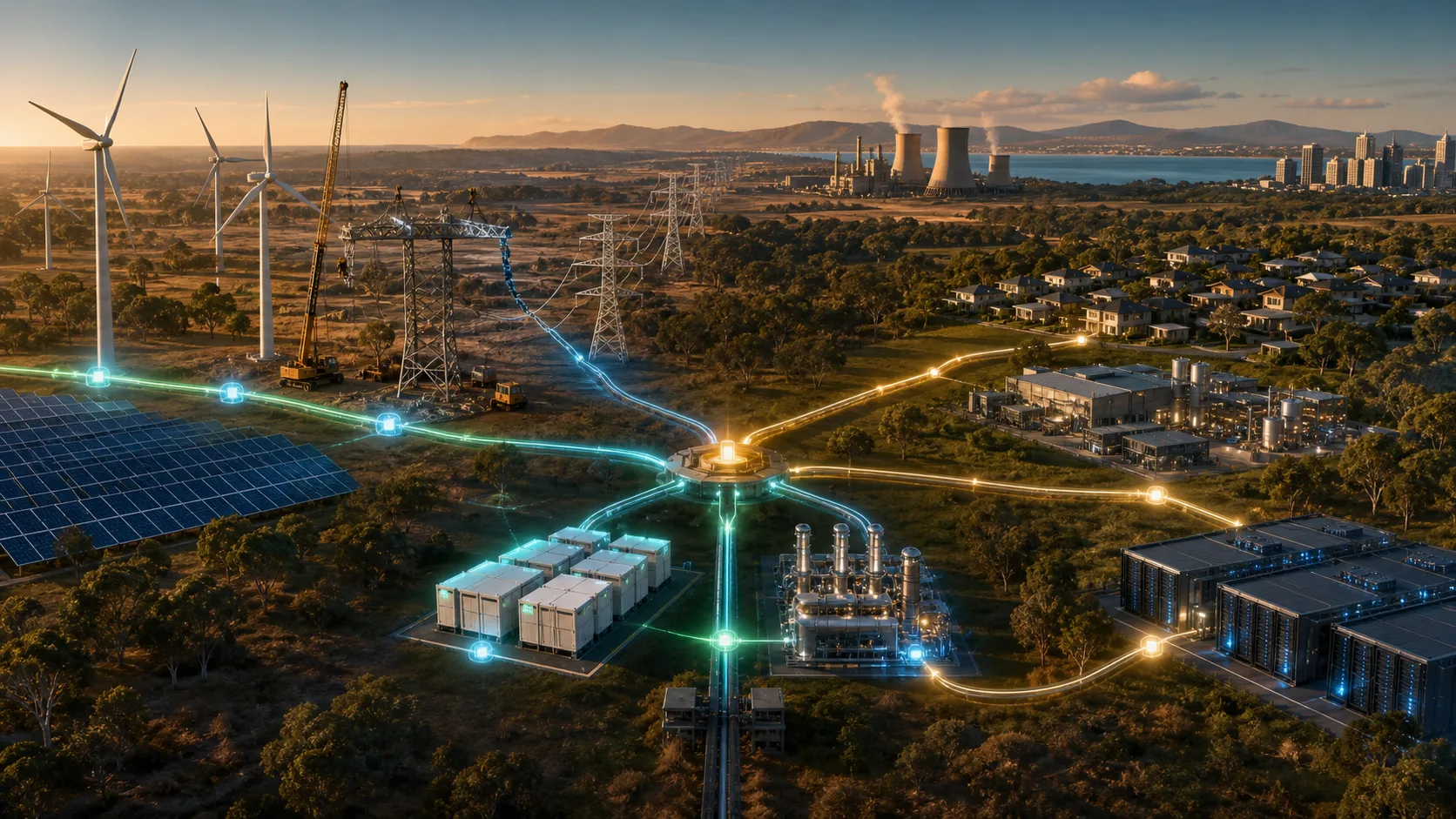
Australia’s electricity transition is not simply a contest between renewable and fossil generation. The investable question is whether transmission, storage, firming and demand response can arrive in the right sequence as ageing coal capacity retires and electricity consumption grows.
The 2026 Integrated System Plan does not say the transition is impossible. It says the least-cost path is renewable generation connected by transmission and distribution, firmed with storage and backed by gas. The risk lies in delivery: a sound model can still produce a difficult operating period if one part of the physical system arrives late.
Targets do not deliver electricity
The Australian Government’s national objective is 82 per cent renewable electricity by 2030. A target describes the intended generation mix, but reliability depends on projects reaching connection, construction and operation.
Announced capacity, financially committed capacity, connected capacity and dependable capacity are not interchangeable. Planning appeals, equipment shortages, connection studies and network constraints can delay the point at which a project supplies the system.
There is real progress as well as delay risk. AEMO reported that a record 9.1 gigawatts of new generation and storage reached full output during the 2026 financial year, more than double the FY2025 result. The broader connections pipeline grew from 53 GW to 75.4 GW. At the same time, the median duration of the developer-led proponent implementation stage increased from 14 to 18 months, and one-third of projects in that stage had been there for more than two years.
Those figures are useful together. They show that capacity is entering the system, while also showing why the whole pipeline cannot be counted as available supply.
Firming is part of the system
Wind and solar can provide low-marginal-cost energy, but the system also needs resources that respond when renewable output falls. Batteries shift energy across hours. Pumped hydro, conventional hydro, gas, demand response and interconnectors cover different durations and system services.
AEMO’s formulation is explicit: renewable generation needs transmission and distribution, storage for firming and gas backup. The relevant measure is therefore not renewable nameplate capacity alone. It is whether the complete combination can meet peaks and extended low-renewable periods with sufficient reserves.
The Australian Energy Regulator’s May 2026 gas-market report makes the same practical point from another direction. Gas-powered generation is not the largest source of domestic gas demand, but its variable demand can affect downstream gas prices when electricity prices are high or winter gas demand is strong. Batteries can displace gas at some times, but that does not make fuel availability, pipeline capacity and storage irrelevant during the periods when gas is needed.
Transmission can be the binding constraint
Much of the new generation is distant from demand centres. Without timely transmission and connection, otherwise economic projects can be curtailed or delayed. Congestion changes regional prices and weakens project returns.
The final 2026 ISP identifies an optimal development path and makes several projects actionable, but an actionable project is not yet a completed line. Investors should track planning approvals, procurement, construction milestones and energisation rather than counting the full modelled capacity as available today.
This is where the broader market-regime framework helps. The announcement is only the first layer. Physical delivery, price formation, company margins and portfolio cash flow determine whether it becomes investable evidence.
Current prices do not prove system failure
Wholesale volatility remains uneven. AEMO’s latest Quarterly Energy Dynamics report found that regional volume-weighted average prices in the second quarter of 2026 ranged from A$60 per megawatt hour in Victoria to A$95 in South Australia. Prices were lower than a year earlier in every National Electricity Market region.
That is an important counter-signal to the claim that the transition is already producing ever-higher wholesale prices everywhere. It is not proof that the system has no constraints. A quarterly average can fall while local congestion, outages or short periods of scarcity still matter for generators, retailers and industrial users.
The AER’s 2026–27 Default Market Offer also combines wholesale, network, environmental and retail costs. A change in the retail reference price cannot be assigned to generation alone.
The portfolio transmission path
Delivery delays can reach portfolios through wholesale volatility, retailer hedging, industrial margins, government support and project write-downs. Energy-intensive manufacturers face a different exposure from regulated networks, renewable developers, storage owners and gas producers.
Data centres require the same discipline. AEMO reported 17 proposed data centres with a combined maximum connection capacity of 9.0 GW in the transmission connection process in the second quarter of 2026. Twelve projects representing 7.6 GW were still at the application stage, while five projects representing 1.4 GW were in proponent implementation.
Maximum proposed capacity is not connected load. The relevant sequence is application, contracted capacity, construction, energisation and utilisation. Treating the entire queue as immediate demand would overstate both the near-term electricity requirement and the revenue opportunity for companies expected to serve it.
What would change the view
The delivery risk falls if transmission milestones are met, firming capacity is commissioned on schedule, reserve margins improve and new loads obtain credible connection plans. It rises if coal outages accelerate, major network projects slip, curtailment grows and volatility leads to industrial closures or repeated fiscal support.
The official evidence supports the direction of the transition while making its dependencies visible. The useful investment view is therefore neither “the transition cannot work” nor “the target guarantees success”. Timing, physical connection and firm capacity determine whether the least-cost model becomes an operating system.
This article provides general information only and does not take account of your objectives, financial situation or needs. It is not personal financial advice or a recommendation to buy, sell or hold a security or any financial product.
Sources
- Australian Energy Market Operator, 2026 Integrated System Plan
- Australian Energy Market Operator, Quarterly Energy Dynamics
- Australian Energy Market Operator, NEM connections scorecard reflects record result for FY26
- Australian Energy Regulator, Wholesale gas performance report 2026
- Australian Government, Renewable Energy Transformation Agreements
- Australian Energy Regulator, Default Market Offer 2026–27
More through this lens