The Regime Investor· ·7 min read
Debt recycling in Australia: trace the money before the tax claim
A plain-English map of offset cash, redraw borrowing, loan splits and mixed-purpose debt — plus the records and advice boundaries that matter.
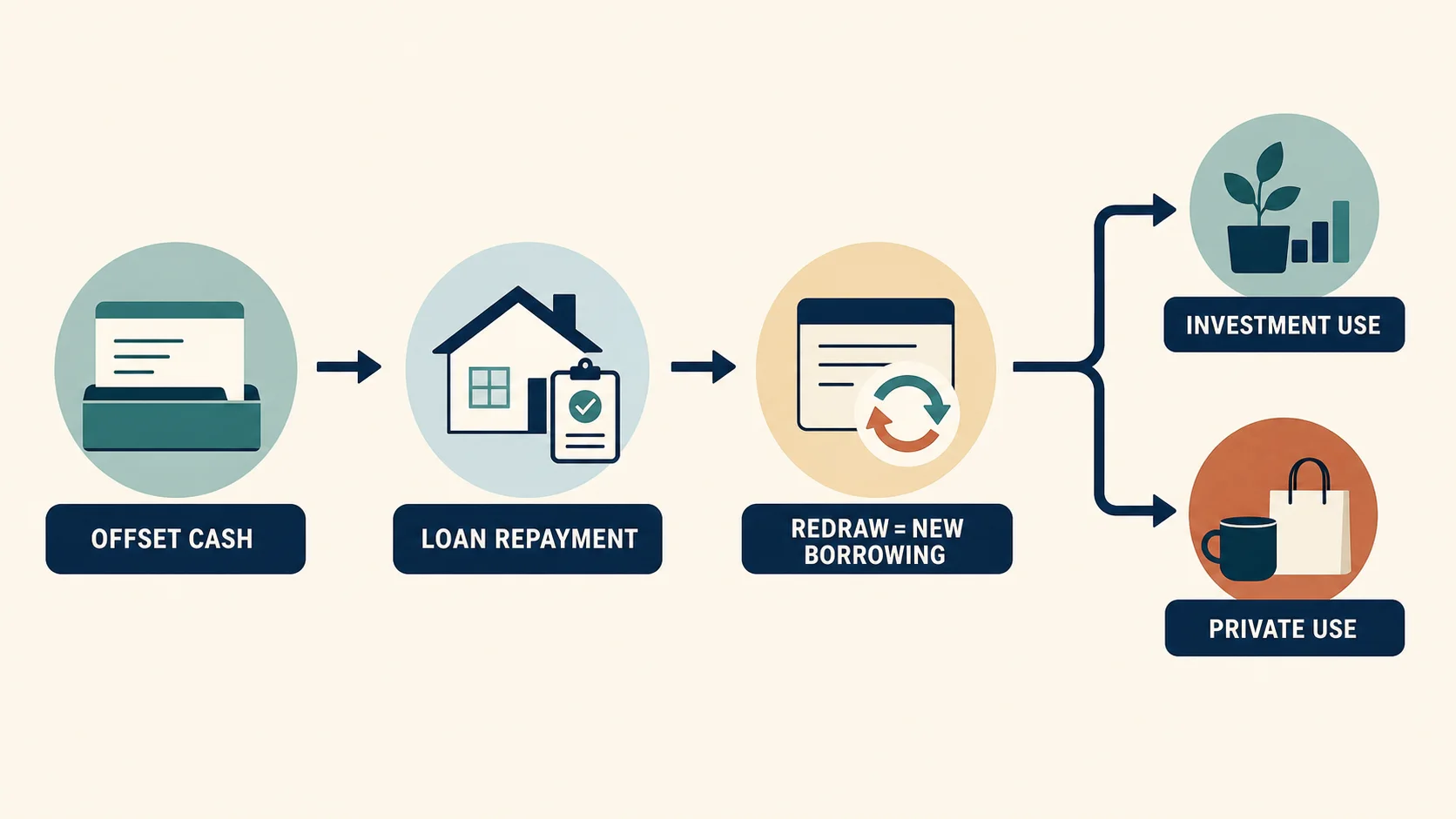
Debt recycling is often described as a sequence: use cash to reduce a home loan, borrow again to invest, then repeat. That summary is easy to remember. It is not enough to establish what the new borrowing was used for, whether interest may be deductible, or whether taking more investment risk suits a household.
The useful question is not, “Did I debt recycle?” It is, “Can every dollar be followed from its source, through the loan, to its final use?” The account names help organise that evidence, but they do not replace it.
Start with four different things, not one mortgage balance
An offset account, an extra repayment, a redraw and a loan split can all reduce or reorganise the same mortgage. They are still different events.
Money in an offset remains cash in a separate transaction account linked to the home loan. It generally reduces the loan balance on which interest is calculated while remaining accessible under the account terms. An extra repayment instead goes into the loan and reduces the debt. Redraw is later access to extra repayments, subject to the lender’s terms.
For tax analysis, the later redraw is important because the ATO treats it as a new borrowing. The use of that new borrowing matters. The home securing the loan, the account label and the broader strategy name do not by themselves decide the result.
A loan split is an accounting structure within the lending arrangement. It can make different uses easier to separate, but calling a split “investment” does not prove where its money went.
For the operational check after a loan change, see whether an offset remains correctly linked after refinancing .
Map the money flow that changes the tax question
Consider an illustrative flow, not a recommendation:
cash sits in an offset account;
cash is paid into the home loan, reducing the principal;
an amount is later redrawn, creating a new borrowing; and
that redraw is transferred to its actual destination.
The last step is where the evidence needs to become specific. A direct transfer from the redraw to an investment settlement account is easier to reconcile than a transfer through an everyday account containing salary, bills, refunds and private purchases. If part of the redraw pays an investment cost and part pays a private cost, the borrowing has more than one purpose.
This is why the phrase “recycled debt” is not a tax conclusion. Under the general deduction rule, the connection between an expense and producing assessable income matters, and private or domestic expenditure is excluded. The ATO’s redraw ruling applies that logic to each new borrowing and its use.
Mixed-purpose debt is an ongoing record problem
When one borrowing funds both income-producing and private uses, interest must be apportioned on a fair and reasonable basis. The problem is not confined to the day of the private transaction.
The ATO describes a mixed-purpose account as one undivided debt. Ordinary principal repayments reduce its private and income-producing components proportionally. A borrower generally cannot keep all the investment component outstanding while treating repayments as if they reduced only the private component.
Repeated investing can therefore increase the bookkeeping burden. A weekly purchase program is not automatically a tax problem, but every redraw and destination still needs to be identified. The trail becomes harder to reconcile when amounts pass through a mixed cash account, sit uninvested, fund fees or private expenses, are refunded, or return after an asset sale.
If a private transaction has entered the same borrowing, a neat spreadsheet prepared later may help explain the history, but it does not undo it.
A separate split helps the evidence, not the label
The ATO says separate subaccounts used exclusively for separate purposes can be treated by reference to their own use. That makes separation useful. It is not a universal implementation instruction.
The relevant loan features, minimum split sizes, redraw rules, settlement steps and fees depend on the lender and contract. A split also stays clean only if its actual transactions stay consistent with its stated purpose. Private transfers, mixed settlement amounts or recycled proceeds can still complicate the analysis.
Before relying on a structure, ask what the lender will record, which account will receive the redraw, how the money reaches the investment, and what statements will exist afterwards. Product mechanics belong with the lender or mortgage broker; the tax treatment belongs with a registered tax practitioner.
Build a trail a stranger can reconcile
A useful record is chronological and account-specific. Keep:
the loan, split and offset statements covering each movement;
redraw confirmations and transaction references;
bank records showing the destination of each draw;
settlement records or brokerage cash-account entries;
investment contract notes and ownership details;
income records connected with the investment;
annual loan-interest summaries; and
a worksheet matching each borrowing, date, amount, use and supporting document.
Direct transfers reduce ambiguity. If an intermediate account is unavoidable, preserve the full statement and avoid assuming that the same dollar can be identified after unrelated cash has moved through it. The record should let a tax practitioner reconstruct what happened without relying only on memory or intention.
Good records do not guarantee a deduction. They make the real facts testable.
The tax result is not the investment result
Even if an amount can be traced to an income-producing investment, borrowing to invest remains a high-risk strategy. Debt magnifies gains and losses. Interest and repayments continue when investment income falls, asset values decline or rates rise. If the home supports the borrowing, failure to meet repayments can put the home at risk.
A possible tax deduction reduces an eligible expense; it does not remove the expense or convert a loss into a gain. Before comparing structures, test the household cash flow against higher rates, lower income, vacancies or dividend cuts, and a prolonged fall in the investment value.
That suitability question is personal financial advice territory. This article does not assess it and does not recommend leverage.
Know which question belongs to which professional
Different uncertainties call for different evidence and qualifications:
A lender or mortgage broker can explain the credit contract, split mechanics, redraw access, fees and transaction route.
A registered tax agent can assess the use of each borrowing, apportionment, records and the tax consequences of later transactions.
A registered financial adviser can assess whether borrowing to invest fits a person’s objectives, financial situation and risk capacity.
Pause before relying on an assumed outcome if private spending has entered the borrowing, ownership and income purpose do not align, money cannot be traced through an intermediate account, an investment has been sold or refunded, repeated draws cannot be reconciled, or a refinance has changed the accounts. Those are signs that the facts need to be reconstructed, not that a particular result follows.
Prove the path before relying on the outcome
Before treating interest as connected with an investment, be able to answer six questions:
Was the money still in an offset, paid into the loan, or redrawn as a new borrowing?
Which exact loan or split produced each redraw?
Where did each amount go next?
Was any amount used privately or mixed with unrelated cash?
Can the path be reconciled from lender statements to investment records?
Which parts require lender confirmation, registered tax advice or personal financial advice?
The discipline is simple even when the transactions are not: identify the borrowing, trace its use, preserve the documents and separate tax mechanics from investment suitability.
Official sources
Federal Register of Legislation, Income Tax Assessment Act 1997, section 8-1
Tax Practitioners Board, Finding and using a tax practitioner
This article provides general educational information only. It is not personal tax, credit, legal or financial advice. Tax outcomes, lender terms and suitability depend on individual facts; obtain qualified advice before acting.
More through this lens