The Regime Investor· ·11 min read
ASX solid-state battery stocks: LIS, CRR and ATC stages
A filing-based comparison of Li-S Energy, Critical Resources and Altech, separating semi-solid cells, lab research and a discontinued project.
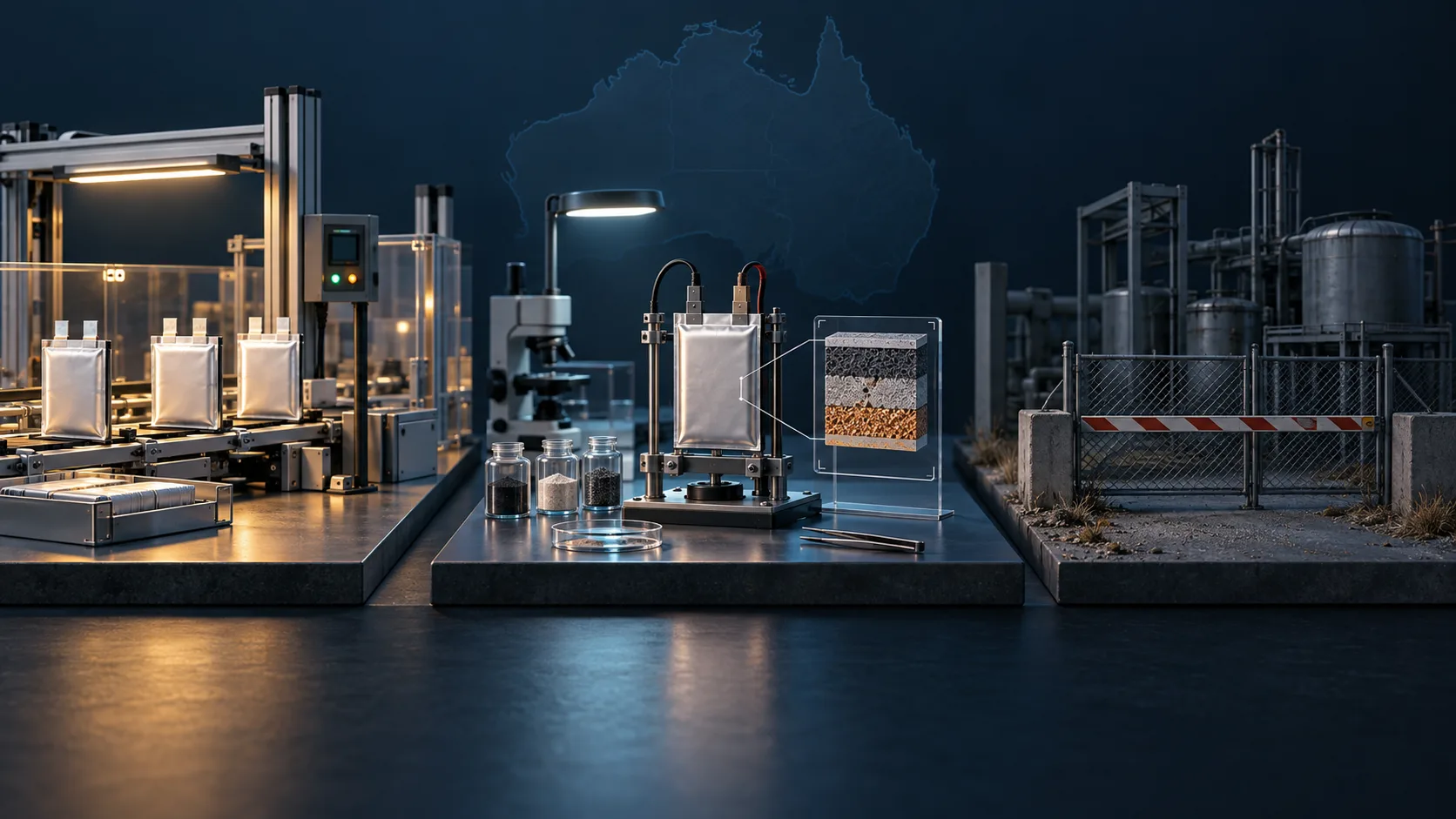
As at 24 September 2026, the three ASX names in this comparison do not offer the same kind of solid-state-battery exposure. Li-S Energy (ASX:LIS) describes its current cells as semi-solid-state, while its all-solid-state work is a separate research program. Critical Resources (ASX:CRR) has reported a laboratory pouch-cell result, but the cell still used a conventional liquid-reference electrolyte and did not contain CRR’s proprietary amorphous solid electrolyte. Altech Batteries (ASX:ATC) discontinued the CERENERGY project, and its German project company was expected to file for insolvency.
The short answer is therefore not a ranking. LIS has the most advanced current cell-production activity of these three, but not a verified scaled all-solid-state battery business. CRR is earlier-stage research and evaluation. ATC should not be counted as active CERENERGY exposure simply because older company or market-profile pages still describe the project.
Disclosure: The author or operator may hold shares in LIS, CRR, ATC, broad Australian equity funds or other assets discussed here. This article was not commissioned or sponsored by any company, broker or product issuer mentioned, and it contains no affiliate or broker-referral links.
Current ASX solid-state-battery exposure at a glance
| ASX company | What the company currently has | Verified stage as at 24 September 2026 | What would materially strengthen the case |
|---|---|---|---|
| Li-S Energy (ASX:LIS) | Semi-solid-state lithium-sulphur cells; separate all-solid-state lithium-sulphur R&D | Geelong pilot line complete; small-scale cell production; cells delivered to US Army DEVCOM for testing; first commercial battery sale targeted for FY27 | A disclosed battery-cell sale, repeat customer orders, independent performance validation and evidence that production economics scale |
| Critical Resources (ASX:CRR) | Evaluation program testing a dry, solvent-free cathode layer that combines lithium iron phosphate (LFP), lithium lanthanum zirconium oxide (LLZO) as a reference solid electrolyte and carbon nanotubes; separate proprietary amorphous solid-state electrolyte (ASE) work | One hand-built laboratory pouch cell ran for about 780 hours and 65 cycles at 0.2C—a slow rate equivalent to roughly five hours for a full charge or discharge—and retained about 75% of its initial charge-storage capacity per unit mass, about one-quarter below its starting level; liquid-reference electrolyte still used and ASE not integrated | Integration of ASE into a full cell, repeatable results across multiple cells, larger-format validation and evidence beyond hand-built laboratory manufacture |
| Altech Batteries (ASX:ATC) | Former CERENERGY sodium-chloride solid-state battery project | Project discontinued after an unsuccessful strategic-partner search; project company expected to file for insolvency; no further ATC funding | A new, formally disclosed project or transaction would be needed before treating ATC as current battery-project exposure |
This table classifies technology and project stage. It does not rank expected share returns, balance-sheet quality or suitability for an individual investor.
Li-S Energy: semi-solid cells now, all-solid-state work still in R&D
Li-S Energy’s current cell program is easy to overstate because the company’s work spans more than one technology path. Its 16 September 2026 investor presentation calls the present lithium-sulphur cell chemistry semi-solid-state. The same presentation says the production line in Geelong is complete, small-scale cell production is under way and cells have been delivered to US Army DEVCOM for testing.
Those milestones are more advanced than a laboratory concept, but each still has a boundary. Delivery for testing is not a customer acceptance result. Small-scale production is not evidence of profitable volume production. The company’s target of a first commercial battery sale in FY27 is a forward target, not a completed sale.
The distinction matters because Li-S Energy separately describes an all-solid-state lithium-sulphur collaboration under the SafeREnergy research program . That work should not be used to relabel the cells coming from the present line as all-solid-state. The investor question is not whether the company can use the phrase “solid state” somewhere in its research portfolio. It is which chemistry is in the current cell, what has been independently tested and what has generated repeatable battery-cell revenue.
The 24 July 2026 June-quarter report also needs careful reading. It reported a first commercial sale of lithium foil. Lithium foil can be relevant to the company’s cell platform, but a foil sale is not a battery-cell sale. Similarly, export approval for prototype cells and a shipment for evaluation show that external testing can occur; they do not establish scaled adoption.
For LIS, the next useful evidence is therefore commercial and repeatable: a named battery-cell sale or contract, the product and quantity supplied, customer validation, subsequent orders, production yield and economics. Until then, the fairest description is a semi-solid-state cell company moving through pilot and customer-testing steps, with a separate all-solid-state R&D program.
Critical Resources: a laboratory cathode result is not an all-solid-state cell
Critical Resources presents the opposite classification problem. Its disclosures discuss solid-state-battery evaluation, a reference solid-electrolyte material and a separate proprietary amorphous solid-state electrolyte, but the reported pouch-cell architecture has not yet combined all of those elements.
The 24 July 2026 quarterly report described a full-format pouch-cell baseline using liquid electrolyte. It also said the company’s amorphous solid electrolyte, or ASE, had not yet been integrated into the pouch-cell architecture. That makes the baseline useful for later comparison, but it is not evidence of a working all-solid-state battery.
The 10 September 2026 technical update moved the laboratory work forward without closing that gap. CRR reported a single hand-built pouch cell whose cathode was made by dry solvent-free deposition (DSD), a process that forms the layer without liquid solvents. The cathode combined lithium iron phosphate (LFP), the active material, with lithium lanthanum zirconium oxide (LLZO), used here as a reference solid electrolyte, and conductive carbon nanotubes.
The cell ran for about 780 hours and 65 cycles at 0.2C—a slow test rate equivalent to roughly five hours for a full charge or discharge—and retained about 75% of its initial specific capacity. That means its charge-storage capacity per unit mass was about one-quarter below its starting level after 65 cycles; it does not establish commercial cycle life or durability. The update also said the cell still used conventional liquid-reference electrolyte, CRR’s proprietary ASE had not yet been integrated and the work was not commercial manufacturing.
That result can be meaningful as an experiment: it gives the company a reference build and a way to test a dry cathode approach. It cannot carry the stronger conclusion that CRR has demonstrated a commercial all-solid-state cell. One hand-built cell does not show repeatability across a batch, production yield, large-format durability or cost competitiveness. The company’s explanation for the observed capacity fade also remains an issuer interpretation until independent and repeatable evidence supports it.
CRR has described an exclusive option over solid-state intellectual property. An option is not the same as an exercised commercial licence. The next evidence should show whether the option has been exercised and on what disclosed basis, whether ASE has been integrated into a complete cell, and whether multiple cells reproduce the result under relevant testing conditions.
For CRR, the correct present label is laboratory-stage solid-state evaluation with a liquid-reference electrolyte, not a commercial all-solid-state battery platform.
Altech Batteries: CERENERGY is discontinued, not current exposure
Altech Batteries is the clearest example of why an undated stock profile can mislead. A profile may still describe the CERENERGY sodium-chloride solid-state battery project even though the board has ended it.
In its 31 July 2026 ASX announcement , ATC said it had discontinued CERENERGY after an unsuccessful search for a strategic partner. It said Altech Batteries GmbH, the project owner, would be unwound and that Fraunhofer retained the battery-technology patent rights.
The status then deteriorated. In its 10 August 2026 update , ATC said the German company was expected to file for insolvency and that ATC would provide no further direct or indirect funding. “Expected to file” should not be rewritten as completed insolvency, but it superseded the earlier expectation of a solvent winding-up.
Two boundaries follow. First, discontinuing CERENERGY does not mean ATC has no other assets or activities. Second, it does mean that CERENERGY should not be presented as a current operating solid-state-battery project without a later formal disclosure that re-establishes exposure. The patents also should not be described as ATC-owned when the company’s announcement says Fraunhofer retained them.
The investment lesson is wider than one ticker: historical project descriptions decay. A current issuer filing that closes a project outranks an older product page, sector list or company profile that still describes the previous plan.
Why technology stage matters more than the label
“Solid-state battery” can refer to a research objective, one component, a partial cell architecture, a prototype, pilot production or a product sold repeatedly to customers. Those stages do not carry the same technical or financial meaning.
For a small listed company, the distance between them is also a financing problem. Laboratory work consumes cash before it produces reliable revenue. Pilot production adds equipment, yield and quality-control risk. Customer testing adds time and the possibility that a promising specification will not translate into an order. Scaling then requires working capital and often a partner, offtake agreement or fresh capital.
This is why a large theoretical battery market does not flow directly into shareholder cash flow. Revenue must first arrive under a contract; cash collection must exceed the operating and capital costs required to deliver; and any new capital raised along the way affects existing shareholders. ATC’s unsuccessful partner search shows the project-level consequence when external support does not arrive. LIS’s testing and FY27 sales target show the gap between a produced cell and recurring sales. CRR’s single laboratory cell shows the earlier gap between an experiment and a manufacturable product.
For household cash-flow planning, speculative project shares should not be treated like cash simply because their market value is visible in a brokerage account. Their price and liquidity can change well before technology or revenue evidence improves. Money needed for near-term expenses, debt service or a planned purchase therefore has a different job from money deliberately exposed to long development timelines and possible capital raisings.
Australia’s funding backdrop can stretch the cash-conversion timeline
As at 24 September 2026, the funding backdrop adds another timing variable. On 11 August 2026 , the Reserve Bank of Australia left the cash rate at 4.35% after three increases during 2026 and assessed monetary policy as somewhat restrictive. Its August financial-conditions assessment said business lending rates had risen, while aggregate funding remained readily available. Those economy-wide conditions do not establish any named issuer’s borrowing cost, funding access or probability of raising capital.
Customer and partner budgets can transmit the same backdrop into project timing. The RBA’s August liaison evidence said investment intentions had eased but remained positive, with more cautious plans and possible delays. Slower capital expenditure can lengthen testing, procurement and order conversion. That is a mechanism, not evidence that any LIS, CRR or ATC customer has delayed a project.
Policy support does not remove the technology-stage test. Under the Australian Government’s Capacity Investment Scheme , project owners bid in competitive tenders and selected renewable-generation or clean-dispatchable projects, including battery storage, receive a long-term revenue safety net intended to reduce investor risk. It is not a purchase order, issuer endorsement, customer relationship or selection of solid-state chemistry for LIS, CRR or ATC.
Longer testing or procurement can extend the pre-revenue cash period and increase potential capital needs and dilution, without proving either will occur. The view would improve with easier policy, lower business lending rates, stronger investment intentions and fewer delays, or funded orders tied to an issuer’s actual chemistry. It would weaken if rates or caution increased, milestones slipped, or cash use rose without matching commercial evidence.
A practical evidence ladder for future filings
When a new announcement arrives, place it on an evidence ladder rather than reacting to the strongest phrase in the headline.
Technology identity: Does the filing say semi-solid-state, all-solid-state, a solid electrolyte, a cathode process or only a target application?
Cell integration: Are all claimed components inside one working cell, or is the result still a liquid-reference baseline or component test?
Replication: Is the result from one hand-built cell, a batch, an independent laboratory or a customer test?
Manufacturing stage: Is the company making laboratory samples, pilot batches or repeatable commercial volumes with disclosed yield and quality control?
Commercial evidence: Is there a testing shipment, a paid battery-cell sale, repeat orders or a material supply contract?
Rights and dependencies: Does the company own or license the relevant intellectual property, and are partner, funding and option conditions satisfied?
Cash-flow bridge: What revenue, cost, capital expenditure and dilution would be required before the project could affect value per share?
The classification should change when the evidence changes. LIS would move forward with verified battery-cell sales and repeat orders, not merely another testing shipment. CRR would move forward when its ASE is integrated into a complete cell and repeatable testing supports the architecture. ATC would return to the active list only if a new formal disclosure establishes a current battery project or transaction.
The bottom line
As at 24 September 2026, LIS, CRR and ATC sit in three different buckets. LIS has semi-solid-state cells in small-scale production and external testing, plus separate all-solid-state R&D. CRR has a laboratory evaluation result that still relies on liquid-reference electrolyte and has not integrated its proprietary ASE. ATC has discontinued CERENERGY and stopped funding the German project company, which was expected to file for insolvency.
That classification is more useful than a “top solid-state battery stocks” list because it identifies what is actually present, what is still missing and which filing could change the conclusion. It says nothing about which share will perform best.
This article is general information only. It does not consider your objectives, financial situation or needs and is not personal financial advice. Verify the latest issuer announcements and consider whether speculative, early-stage exposure fits your own circumstances before making an investment decision.
More through this lens