The Regime Investor· · ·10 min read
When silver miners can outperform silver — and what has to go right
Silver miners can amplify a rising metal price, but grades, recovery, costs, capital and funding determine whether leverage becomes durable cash flow.
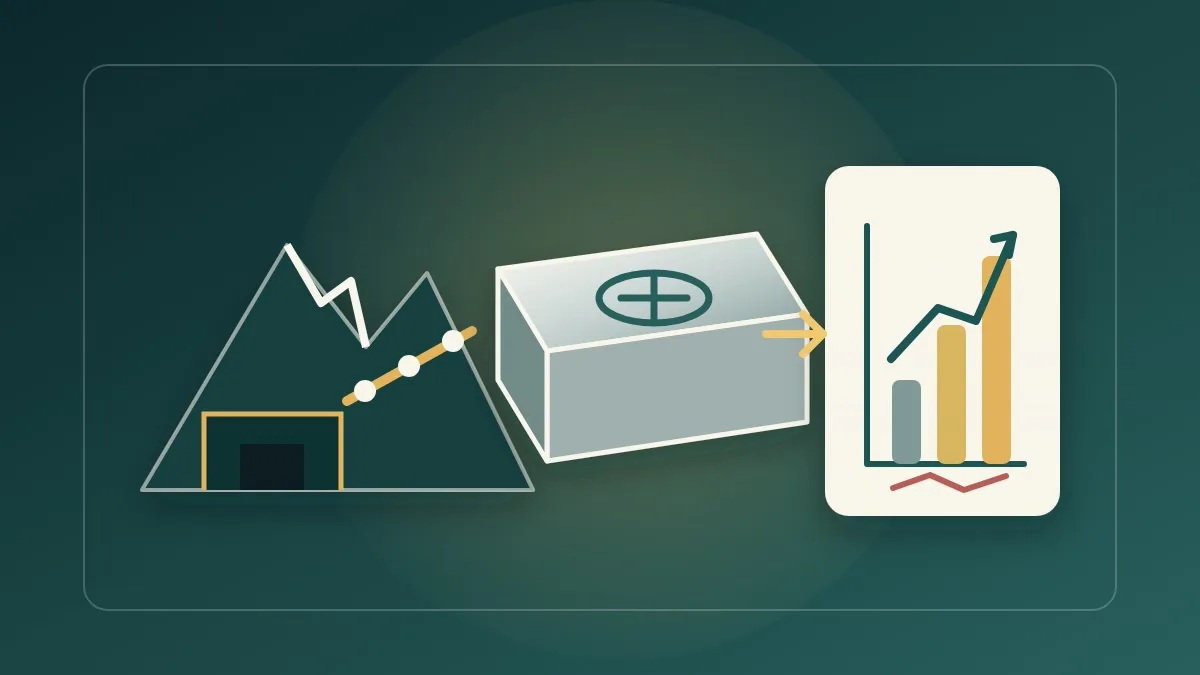
A rising silver price can make a mine’s profit grow much faster than the metal itself. That operating leverage is the attraction. It is also the trap.
Silver shares are not silver with extra upside. They are operating businesses with wages, power bills, permits and funding needs. Ore grade is the amount of silver in each tonne of rock; recovery is the share of that silver the processing plant extracts. Sustaining capital pays to keep the existing mine operating. When several of those variables move against the investor, a miner can disappoint even while the silver price rises.
Why miners can move faster than the metal
Consider a simplified mine that receives US$40 per ounce of silver and incurs US$30 per ounce of total cost. Its margin is US$10. If the realised price rises to US$50 and the cost stays fixed, the silver price has risen 25 per cent but the margin has doubled to US$20.
That is operating leverage. The same arithmetic works in reverse. If the silver price falls or the cost base rises, the margin can contract far more quickly than the metal price.
The example is deliberately simple. A real company may receive revenue from gold, lead or zinc by-products; report all-in sustaining cost (AISC) on a silver-equivalent or by-product-credit basis; hedge part of production; and spend cash on development that is not visible in a headline cost figure. Silver-equivalent figures translate other metals into silver ounces using assumed relative prices; by-product credits subtract revenue from those other metals from the reported silver cost. AISC includes sustaining expenditure but may leave out growth spending and other cash needs. Investors need to rebuild the economics from the company’s reports rather than treating one cost metric as the whole answer.
A supportive silver market is only the starting point
The Silver Institute’s April 2026 survey estimated that mined supply rose 3 per cent to 846.6 million ounces in 2025, while total demand was about 1.13 billion ounces. The market remained in deficit for a fifth consecutive year. The same survey forecasts a sixth annual deficit in 2026 and industrial fabrication of 639.6 million ounces, down about 3 per cent from 657.4 million ounces in 2025, as photovoltaic manufacturers use less silver and substitute other materials. This is the April forecast, not the preliminary February outlook of about 650 million ounces and a 2 per cent decline; neither is a completed 2026 result.
That combination matters. Supply can be constrained while parts of demand soften. A market deficit can support the metal without guaranteeing a straight-line price rise, and a higher metal price can encourage recycling, hedging and new mine investment.
Silver supply is also unusual because much of it is produced as a by-product of lead, zinc, copper and gold mines. The Silver Institute’s preliminary February 2026 outlook expected primary silver-mine output to remain broadly flat and contribute about 28 per cent of mined output in 2026. That is a dated forecast, not a realised production share or a figure taken from the April survey. A higher silver price does not immediately switch on all supply, because many production decisions are driven by the economics of another metal.
For a primary silver producer, that can be favourable. For an investor, it means that industry-level scarcity and company-level performance must be analysed separately. The deficit is a market-balance estimate, not a forecast of any miner’s margin.
Translate the metal thesis into company economics
For a miner to outperform the metal, the price move must survive several deductions:
- Silver price → the realised price after hedging
- Realised price → revenue after treatment, refining and payability charges
- Revenue → operating margin after labour, energy, reagents and maintenance
- Operating margin → cash from operations after changes in cash tied up in inventory, customer payments and supplier bills, cash taxes and any royalties not already included in operating costs
- Cash from operations → free cash flow after sustaining and growth capital
- Free cash flow → cash available to shareholders after remaining financing obligations, with any new shares reducing each existing holder’s ownership
A spot-price rally can fail to reach shareholders if grades fall, recoveries disappoint, costs rise or new projects require repeated equity issuance. The chain also shows why a company can outperform when the metal rises only modestly: improving grade, recovery, throughput or funding terms can widen the margin from both directions.
What has to go right at the mine
- Production must rise for the right reason. Higher tonnes are helpful only if grade and recovery do not collapse.
- Realised prices must reach the income statement. Hedging, treatment charges and payability terms can create a gap between spot silver and what the miner receives.
- Unit costs must stay controlled. Labour, diesel, power, explosives, contractors and maintenance can absorb the price gain.
- Sustaining and growth capital must be funded. Accounting profit is less useful if the mine continually consumes cash to replace equipment or reach new ore.
- The balance sheet must survive the ramp-up. Delays can force a small miner to raise equity when its bargaining power is weakest.
- Permits and community relationships must hold. A technically attractive orebody can still lose years to political, environmental or social disruption.
A live example of why the details matter
Kuya Silver’s Bethania project in Peru illustrates the questions without serving as a recommendation. The company reported that it mined 5,097 tonnes of mineralised material in the June 2026 quarter, 66 per cent more than in the preceding quarter, and processed 23,912 ounces of silver. It also reported an average silver recovery of 79.7 per cent and said lower-grade development material affected the early part of the quarter.
The positive reading is that tonnes, underground development and monthly production were increasing during the ramp-up. The more cautious reading is that grade, recovery, processing terms and funding still determine whether higher throughput becomes sustainable free cash flow.
This is the distinction investors should preserve. An operational milestone is evidence of progress, not proof that the mine has reached steady-state economics. The next reports need to show whether improved grades and recoveries persist, whether unit costs fall with scale, and whether the company can fund development without repeated dilution.
M&A is optionality, not the base case
Tight supply and wider margins can encourage acquisitions, but a takeover premium should not be the central valuation method. A prospective buyer still has to assess jurisdiction, reserve life, metallurgy, infrastructure, environmental liabilities and the capital needed to bring ounces into production.
The stronger thesis is that a high-quality asset may become strategically scarcer. The weaker thesis is that every small producer becomes a target. If takeover interest matters to the valuation, binding bids and disclosed terms carry more weight than market rumours.
How to compare a miner with owning silver
Bullion or a physically backed exposure is mainly a view on the metal price, less fees and tracking effects. A miner adds company-specific variables and equity-market risk. The comparison should therefore start with the job the asset is meant to do.
If the objective is direct silver-price exposure, a miner may introduce unwanted operational and funding risk. If the objective is leveraged participation in a favourable silver cycle, a profitable producer with a sound balance sheet and credible growth plan may offer more upside — alongside a larger downside.
The choice between the metal and a mining business also depends on the intended portfolio role. Gold and silver as portfolio insurance compares direct precious-metal exposure, Australian investment vehicles, currency effects and holding costs.
For ASX-listed silver and polymetallic companies, the label “silver stock” is not enough. Some projects are pre-revenue. Some receive most revenue from another metal. Some report a large silver-equivalent resource but require years of permitting and capital before production. Each belongs in a different risk bucket.
Silver is not Tier 1 capital
The Basel III definition of capital uses Tier 1 to describe regulatory capital that can absorb a bank’s losses while it remains a going concern. It comprises Common Equity Tier 1 and Additional Tier 1 instruments. It is not a designation that turns silver into a Tier 1 reserve asset.
Any claim that a rule change has reclassified silver should identify the regulator, eligible instrument, legal text and effective date. Without that evidence, industrial demand, mine supply, inventories, investment flows and company economics remain the relevant variables.
A practical checklist
- Production: tonnes mined and processed, payable silver output and guidance delivery
- Ore quality: head grade, reserve grade, dilution and mine-life trend
- Recovery: actual metallurgical recovery and changes in ore mix
- Economics: realised price, treatment charges, AISC and total cash expenditure
- Cash conversion: operating cash flow, sustaining capital, growth capital and free cash flow
- Funding: net cash or debt, liquidity runway, hedging and likely equity issuance
- Asset risk: jurisdiction, permits, taxes, infrastructure and community agreements
- Valuation: enterprise value per producing ounce and free-cash-flow sensitivity at lower silver prices
What would change the view
The case for miners outperforming silver would strengthen if:
- realised silver prices rose faster than unit costs;
- grades, recoveries and reserve life remained credible;
- free cash flow improved without material dilution;
- balance sheets could fund development through a downturn; and
- any takeover thesis progressed from rumours to binding bids.
The view would weaken if thrifting and substitution reduced demand faster than expected, recycling or by-product supply expanded, costs absorbed the metal-price gain, reserve grades deteriorated or companies repeatedly issued shares to finish construction and development. A falling silver price would expose the same leverage in reverse.
Conclusion
Silver miners can outperform silver, but the metal price is only one input. The better question is whether a specific company can convert that price into durable cash after paying for the mine it already owns and the growth it promises.
Watch tonnes, grade, recovery, total spending and dilution together. If only the silver price is improving, the investment case is incomplete.
Update note
Revision history
This update expands the following sections:
- A supportive silver market is only the starting point
- Translate the metal thesis into company economics
- M&A is optionality, not the base case
- Silver is not Tier 1 capital
- What would change the view
The article now separates the projected 2026 silver deficit from mine-level margins, traces a metal-price move through to shareholder value, and adds evidence tests for takeover and regulatory claims. This makes the conditions for miner outperformance—and the ways the thesis can fail—more explicit.
This article is general information and does not take account of your objectives, financial situation or needs. It is not personal financial advice or a recommendation to buy, hold or sell any security or commodity exposure.
Sources
- The Silver Institute — World Silver Survey 2026
- The Silver Institute — 2026 market outlook
- Bank for International Settlements — Definition of capital in Basel III
- Kuya Silver — Bethania Q2 2026 operational update
Update note
Revision history
This correction separates the February preliminary outlook from the April survey already available at the article’s original evidence cutoff. It uses the April industrial-demand forecast and labels the older primary-mine forecast explicitly. The cash-flow bridge now accounts for working capital, cash taxes and royalties before free cash flow, then distinguishes financing obligations and ownership dilution. Short explanations of ore grade, recovery, sustaining capital and cost-reporting bases make the operating comparison easier to follow. It does not refresh the whole market view.
- Introduction
- Why miners can move faster than the metal
- A supportive silver market is only the starting point
- Translate the metal thesis into company economics
More through this lens